 Post by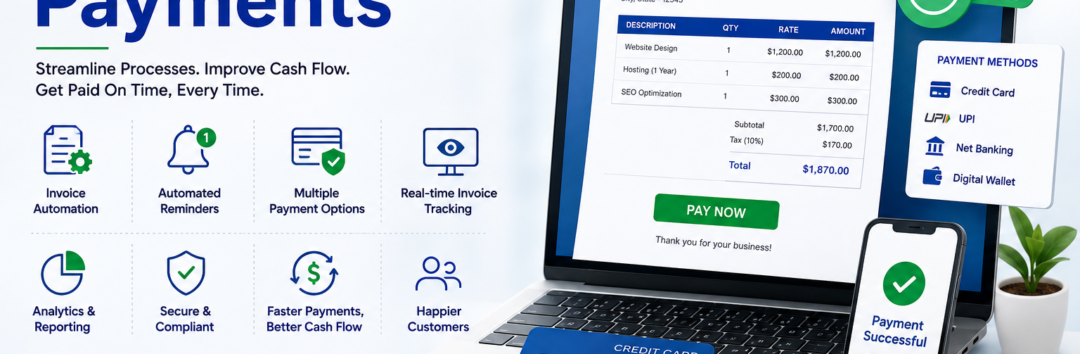
Learn the best practices for faster invoice payments with automation, payment reminders, invoice processing, accounts receivable strategies, and cash flow optimization.
Late invoice payments are one of the biggest challenges businesses face today. Whether you’re a freelancer, startup founder, agency owner, retailer, manufacturer, or enterprise finance team, delayed payments can significantly impact Business Cash Flow, limit growth opportunities, and increase operational stress.
Imagine delivering excellent work, sending the invoice, and then waiting 30, 60, or even 90 days for payment. During that time, you still need to pay salaries, suppliers, software subscriptions, office rent, and taxes. This is why implementing the Best Practices for Faster Invoice Payments is essential for businesses of every size.
Modern companies are moving away from manual billing processes and embracing Invoice Automation, Electronic Invoice (e-Invoice) solutions, and intelligent finance platforms that reduce manual work while improving payment speed. Businesses that streamline their Invoice Processing often experience healthier cash flow, improved customer relationships, and fewer collection issues.
The good news is that getting paid faster isn’t about aggressively chasing customers. It’s about creating a professional invoicing system that minimizes friction throughout the payment journey—from invoice creation to payment confirmation.
In this comprehensive guide, you’ll learn practical strategies used by successful businesses to accelerate collections, improve invoice accuracy, reduce disputes, and optimize every stage of the payment lifecycle.
Whether you’re issuing ten invoices a month or ten thousand, these best practices will help you build a more efficient invoicing process and strengthen your financial operations.
Why Faster Invoice Payments Matter
Many business owners focus heavily on increasing sales but overlook the importance of collecting payments efficiently.
Revenue only becomes useful when it reaches your bank account.
If payments are delayed, your company may struggle with:
- Paying employees
- Purchasing inventory
- Investing in marketing
- Managing suppliers
- Expanding operations
This is why finance professionals closely monitor Cash Flow Management rather than sales alone.
A healthy invoicing process leads to:
- Improved liquidity
- Better financial planning
- Stronger customer relationships
- Reduced borrowing
- Higher profitability
Businesses with organized invoicing systems generally collect payments faster because customers receive accurate invoices with clear payment instructions.
The Hidden Cost of Late Payments
Late payments affect more than just cash flow.
They also increase:
- Administrative workload
- Follow-up emails
- Customer disputes
- Collection costs
- Financial uncertainty
Finance teams often spend hours manually checking payment status instead of focusing on business growth.
Without proper Invoice Tracking, companies struggle to identify which invoices remain unpaid.
Similarly, poor Invoice Status Tracking makes it difficult to prioritize collection efforts.
Measuring Payment Performance
Successful finance teams don’t rely on assumptions.
They monitor key performance indicators such as:
Days Sales Outstanding (DSO)
Days Sales Outstanding (DSO) measures the average number of days required to collect customer payments.
A lower DSO generally indicates:
- Faster collections
- Better liquidity
- Efficient receivables management
Reducing DSO should be one of the primary goals of every finance department.
Invoice Aging Report
Another essential tool is the Invoice Aging Report.
This report categorizes invoices by age, such as:
- 0–30 Days
- 31–60 Days
- 61–90 Days
- 90+ Days
The report helps identify:
- Outstanding Invoices
- High-risk customers
- Collection priorities
- Payment trends
Businesses reviewing aging reports weekly often resolve overdue invoices much sooner.
Payment Forecasting
Finance teams also rely on Payment Forecasting to estimate incoming cash based on outstanding invoices.
Forecasting helps organizations:
- Plan expenses
- Schedule investments
- Avoid cash shortages
- Improve budgeting
Combined with effective invoice management, forecasting creates greater financial stability.
Understanding the Complete Invoice-to-Pay Process
Many people believe invoicing starts when an invoice is sent.
In reality, payment begins much earlier.
Every invoice follows a structured Invoice-to-Pay (I2P) Process that connects procurement, finance, operations, and customer payments.
Understanding this workflow helps businesses identify delays and eliminate unnecessary bottlenecks.
Step 1: Procurement Process
The payment journey often begins with the Procurement Process.
A customer identifies a business need and requests products or services.
Large organizations usually issue a Purchase Order (PO) before the work begins.
The Purchase Order defines:
- Products
- Pricing
- Quantities
- Delivery expectations
- Payment conditions
Invoices that match approved purchase orders generally receive faster approvals.
Step 2: Supplier Onboarding
A smooth Supplier Onboarding process plays an important role in preventing payment delays.
Businesses should collect supplier information such as:
- Business registration
- Tax information
- Banking details
- Contact information
- Compliance documents
Proper Vendor Management ensures suppliers meet organizational requirements before transactions begin.
Step 3: Goods Delivery and Verification
When physical products are supplied, buyers often create a Goods Receipt Note (GRN).
The GRN confirms:
- Items received
- Quantities delivered
- Product condition
The finance department later compares the GRN with the Purchase Order and supplier invoice.
Step 4: Three-Way Matching
One of the most effective controls in invoice processing is Three-Way Matching.
Finance teams compare:
- Purchase Order
- Goods Receipt Note
- Supplier Invoice
If all three documents match, the invoice proceeds smoothly through the approval process.
If discrepancies appear, payment delays become almost inevitable.
Step 5: Invoice Approval Workflow
Once matching is complete, the invoice enters the Invoice Approval Workflow.
Depending on company size, approvals may involve:
- Department Managers
- Procurement Teams
- Finance Teams
- Senior Executives
Organizations typically define an Approval Matrix that specifies who can approve invoices based on invoice value.
An efficient Approval Routing process ensures invoices move quickly to the right approver without unnecessary delays.
Step 6: Invoice Validation
Before payment, businesses perform Invoice Validation.
This includes verifying:
- Invoice number
- Customer details
- Purchase Order
- Tax calculations
- Payment terms
- Banking information
Accurate validation improves Invoice Accuracy and reduces disputes later in the payment cycle.
Step 7: Payment Scheduling
Once approved, invoices enter Payment Scheduling.
Finance teams schedule payments based on:
- Invoice Due Date
- Cash availability
- Vendor priority
- Payment policies
Some organizations also take advantage of an Early Payment Discount, paying suppliers before the due date in exchange for reduced pricing.
This strategy can strengthen supplier relationships while lowering procurement costs.
Automating Invoice Payments and Optimizing Your Collection Process
Now that you understand the Invoice-to-Pay (I2P) Process, it’s time to focus on one of the most effective ways to accelerate collections—automation. Businesses that rely on manual invoicing often spend countless hours creating invoices, sending follow-ups, tracking payments, and reconciling transactions. By contrast, organizations that embrace digital finance tools can significantly reduce delays, improve accuracy, and strengthen customer relationships.
Embrace Invoice Automation to Eliminate Delays
One of the biggest reasons invoices are paid late is manual processing.
When invoices are created manually, businesses often face:
- Data entry mistakes
- Missing invoice details
- Incorrect payment information
- Delayed approvals
- Forgotten follow-ups
Implementing Invoice Automation eliminates many of these issues by streamlining repetitive tasks.
Modern Invoice Management Software can automatically:
- Generate invoices
- Assign invoice numbers
- Schedule recurring invoices
- Send invoices via email
- Track payment status
- Trigger payment reminders
- Update accounting records
Instead of spending hours on administrative work, finance teams can focus on improving customer service and financial planning.
Improve Invoice Data Capture with OCR and IDP
Many businesses still receive invoices in PDF, scanned, or paper formats. Manually entering this information is slow and increases the likelihood of errors.
Two technologies have transformed this process:
Optical Character Recognition (OCR)
Optical Character Recognition (OCR) extracts text from scanned invoices and converts it into editable digital data.
OCR can automatically capture:
- Invoice Number
- Invoice Date
- Supplier information
- Tax amounts
- Line items
- Invoice totals
This reduces manual typing and improves efficiency.
Intelligent Document Processing (IDP)
While OCR extracts text, Intelligent Document Processing (IDP) goes a step further.
IDP uses artificial intelligence to:
- Classify invoices
- Understand document structure
- Validate extracted information
- Detect missing fields
- Identify anomalies
Businesses handling thousands of invoices each month can dramatically improve Invoice Accuracy and reduce processing time using OCR and IDP together.
Build a Touchless Invoice Processing System
Leading organizations are moving toward Touchless Invoice Processing, where invoices move through the entire payment cycle with little or no manual intervention.
A touchless workflow includes:
- Automatic invoice receipt
- Digital data extraction
- Invoice validation
- Invoice matching
- Approval routing
- Payment scheduling
- Payment confirmation
- Accounting updates
This approach supports Straight-Through Processing (STP), allowing invoices to be processed from receipt to payment without unnecessary human involvement.
The result is faster payments, fewer errors, and lower operational costs.
Automate Invoice Matching and Approvals
Before an invoice can be paid, businesses need to verify that the billed amount is correct.
Modern finance platforms automate Invoice Matching by comparing invoices against:
- Purchase Orders
- Goods Receipt Notes
- Supplier contracts
If the information matches, the invoice automatically proceeds through the approval process.
Combined with predefined Approval Matrix rules and intelligent Approval Routing, invoices reach the appropriate decision-makers without delays.
For example:
- Invoices below ₹10,000 may require only a department manager’s approval.
- Invoices above ₹1,00,000 may require finance and senior management approval.
Automating these rules prevents invoices from sitting in inboxes waiting for manual forwarding.
Integrate Your Finance Systems
Disconnected systems often create duplicate work and inconsistent financial records.
This is why many organizations invest in:
- ERP Integration
- Accounting Software Integration
- Financial Workflow Automation
These integrations allow invoice information to flow automatically between departments.
For example:
- Sales creates an invoice.
- Accounting records the receivable.
- Inventory updates automatically.
- Payment status is synchronized.
- Financial reports are updated in real time.
This connected ecosystem reduces manual data entry and provides better visibility into the payment lifecycle.
Make It Easy for Customers to Pay
Even a perfectly prepared invoice can remain unpaid if the payment process is inconvenient.
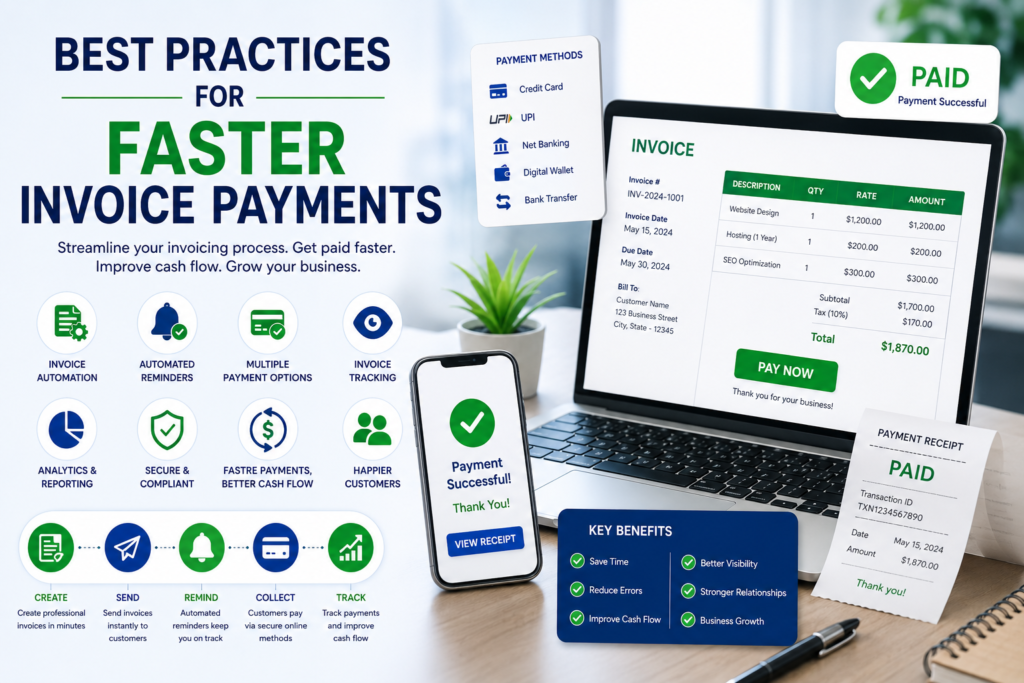
One of the simplest Best Practices for Faster Invoice Payments is reducing payment friction.
Include a Secure Payment Link
Every invoice should contain a clearly visible Payment Link that directs customers to a secure payment page.
Instead of requiring customers to manually transfer funds, they can pay with just a few clicks.
Offer an Online Payment Gateway
Businesses that accept only bank transfers often experience slower payments.
Adding an Online Payment Gateway enables customers to choose the payment method that works best for them.
Common options include:
- Credit Cards
- Debit Cards
- UPI
- Net Banking
- Digital Wallets
- Bank Transfers
Supporting Multiple Payment Methods increases convenience and can significantly reduce payment delays.
Use Recurring Invoices for Subscription Businesses
If your business provides monthly or annual services, manually creating invoices every billing cycle is inefficient.
Instead, use Recurring Invoices.
Recurring invoicing automatically:
- Generates invoices
- Sends invoices
- Applies payment terms
- Reminds customers before the due date
This ensures consistent billing while reducing administrative work.
Industries that benefit include:
- SaaS companies
- Marketing agencies
- Maintenance providers
- Membership organizations
- Consulting firms
Never Let Customers Forget an Invoice
One of the most effective collection strategies is timely communication.
Instead of waiting until invoices become overdue, implement proactive reminders.
Payment Reminder Strategy
A professional Payment Reminder should be:
- Friendly
- Polite
- Helpful
- Consistent
An example schedule:
- Invoice Sent
- 7 Days Before Due Date
- Due Date
- 3 Days After Due Date
- 7 Days After Due Date
- 14 Days After Due Date
Businesses using Automated Payment Reminders collect payments much faster than those relying on manual follow-ups.
Automation also ensures no invoice is forgotten.
Monitor Invoice Status in Real Time
Without visibility, collection efforts become reactive rather than proactive.
Modern invoicing platforms provide comprehensive Invoice Tracking and Invoice Status Tracking.
Typical invoice statuses include:
- Draft
- Sent
- Delivered
- Viewed
- Approved
- Paid
- Overdue
- Cancelled
Tracking invoice status helps finance teams identify payment bottlenecks and prioritize follow-up activities.
Understand Customer Payment Behavior
Not every customer pays the same way.
Analyzing Customer Payment Behavior allows businesses to tailor collection strategies.
Examples:
- Customers who consistently pay early may qualify for an Early Payment Discount.
- Customers with recurring delays may require stricter payment terms.
- High-risk customers may benefit from shorter payment cycles.
This data-driven approach improves both customer relationships and collection efficiency.
Reduce Risk with Credit Assessments
Before extending credit to new customers, businesses should evaluate financial risk.
A Creditworthiness Check helps determine whether a customer is likely to pay on time.
Many organizations also conduct a Credit Risk Assessment before approving large transactions.
These assessments reduce:
- Bad debt
- Late payments
- Collection costs
- Financial uncertainty
Resolve Disputes Quickly
Invoice disputes are among the most common reasons for delayed payments.
An effective Invoice Dispute Resolution process should include:
- Clear communication
- Supporting documentation
- Fast investigation
- Prompt corrections
Maintaining an organized Audit Trail helps finance teams quickly verify invoice history and resolve disagreements.
Prevent Duplicate Payments and Fraud
Businesses should implement safeguards against duplicate or fraudulent invoices.
Key controls include:
- Duplicate Invoice Detection
- Invoice validation
- Approval workflows
- Supplier verification
- Fraud Prevention policies
These controls protect both buyers and suppliers while ensuring financial accuracy.
Advanced Strategies to Accelerate Invoice Payments and Improve Cash Flow
By this stage, you’ve learned how to build an efficient invoicing workflow and automate key processes. However, businesses that consistently receive payments on time don’t stop there. They continuously optimize their finance operations using data, technology, and proactive collection strategies.
In this section, we’ll explore advanced Invoice Processing Best Practices that help businesses improve collections, strengthen supplier relationships, optimize working capital, and maintain long-term financial stability.
Optimize Accounts Receivable (AR) for Faster Collections
Your Accounts Receivable (AR) represents money customers owe your business. While sales may look impressive on paper, they only contribute to growth once payments are collected.
An efficient AR process focuses on:
- Sending invoices immediately after completing work.
- Monitoring payment deadlines.
- Following up on overdue invoices.
- Recording payments accurately.
- Resolving disputes quickly.
Businesses that review their receivables weekly usually experience fewer overdue invoices than those that review them only at month-end.
Best Practices for Accounts Receivable
- Issue invoices without delay.
- Define clear Payment Terms before starting work.
- Send Automated Payment Reminders before and after the due date.
- Monitor Invoice Status Tracking daily.
- Escalate overdue invoices based on their aging category.
- Maintain clear communication with customers.
A proactive AR strategy improves customer relationships while reducing payment delays.
Streamline Accounts Payable (AP)
Although this guide focuses on collecting payments, optimizing Accounts Payable (AP) is equally important.
Efficient AP processes help businesses:
- Build supplier trust.
- Avoid late payment penalties.
- Capture Early Payment Discounts.
- Improve vendor relationships.
- Maintain healthy cash flow.
Businesses that pay suppliers on time often receive better pricing, improved service, and higher credit limits.
Balancing AR and AP creates a stable financial ecosystem where incoming and outgoing cash flows remain predictable.
Strengthen Collections Management
No matter how efficient your invoicing process is, some invoices will inevitably become overdue. This is where effective Collections Management becomes essential.
Rather than waiting until invoices are significantly overdue, establish a structured collection process.
Example Collection Timeline
Day 0: Invoice Sent
Day 7: Friendly reminder
Invoice Due Date: Payment reminder
7 Days Overdue: Follow-up email or phone call
15 Days Overdue: Escalation notice
30+ Days: Formal collection process
A consistent process encourages timely payments without damaging customer relationships.
Handle Debt Collection Professionally
Occasionally, customers may fail to pay despite repeated reminders. In such situations, Debt Collection should be approached professionally and respectfully.
Before initiating formal collection efforts:
- Verify invoice accuracy.
- Confirm delivery of goods or services.
- Review communication history.
- Check for unresolved disputes.
- Offer flexible payment arrangements where appropriate.
Maintaining professionalism protects your company’s reputation while increasing the likelihood of recovering outstanding amounts.
Improve Cash Collection Processes
Successful businesses don’t simply send invoices—they actively manage Cash Collection.
A well-defined collection strategy includes:
- Clear payment instructions.
- Convenient payment methods.
- Automated reminders.
- Real-time payment tracking.
- Prompt acknowledgment of received payments.
The easier you make it for customers to pay, the faster your invoices are likely to be settled.
Simplify Payment Reconciliation
Receiving payments is only part of the process. Businesses must also match those payments to the correct invoices.
This is known as Payment Reconciliation.
Accurate reconciliation ensures:
- Correct customer balances.
- Accurate financial records.
- Reliable reporting.
- Reduced accounting errors.
Most modern accounting systems automatically reconcile payments using invoice references and bank transaction data.
Automate Invoice Reconciliation
Invoice Reconciliation involves verifying that invoices, payments, purchase records, and accounting entries are consistent.
A strong reconciliation process helps identify:
- Missing invoices.
- Duplicate invoices.
- Incorrect tax calculations.
- Payment discrepancies.
- Unmatched transactions.
Automated reconciliation significantly reduces manual work while improving financial accuracy.
Accelerate Cash Application
After receiving customer payments, businesses must allocate those funds to the correct invoices.
This process is called Cash Application.
Without automation, finance teams often spend hours matching payments manually.
Modern finance platforms automatically match payments using:
- Invoice Number
- Customer Name
- Payment Amount
- Transaction Reference Number
- Payment Date
Automated cash application speeds up collections while reducing accounting errors.
Perform Regular Bank Reconciliation
Every finance department should complete regular Bank Reconciliation.
Bank reconciliation compares:
- Bank statements
- Accounting records
- Invoice payments
- Customer deposits
Reconciling accounts regularly helps detect:
- Missing transactions.
- Duplicate entries.
- Banking errors.
- Fraudulent activity.
Monthly—or even weekly—reconciliation improves financial confidence and audit readiness.
Use Invoice Analytics to Improve Performance
Businesses cannot improve what they don’t measure.
Invoice Analytics provides valuable insights into the entire invoicing process.
Useful metrics include:
- Average payment time.
- Collection rate.
- Overdue invoice percentage.
- DSO trends.
- Customer payment performance.
- Invoice approval times.
These insights help finance teams identify bottlenecks and continuously optimize payment performance.
Enhance Financial Reporting
Reliable Financial Reporting depends on accurate invoice and payment data.
Well-organized reports help management understand:
- Revenue trends.
- Outstanding receivables.
- Cash inflows.
- Customer payment habits.
- Collection efficiency.
Real-time reporting also supports better strategic decision-making.
Optimize Working Capital
One of the biggest advantages of faster invoice payments is improved Working Capital Optimization.
When customers pay on time, businesses can:
- Invest in growth.
- Purchase inventory.
- Hire employees.
- Launch marketing campaigns.
- Reduce borrowing costs.
Healthy working capital creates financial flexibility and strengthens long-term business resilience.
Manage the Complete Invoice Lifecycle
Every invoice follows a journey—from creation to final payment.
This journey is known as Invoice Lifecycle Management.
Typical stages include:
- Invoice Creation
- Invoice Validation
- Customer Delivery
- Approval
- Payment Reminder
- Payment Collection
- Payment Confirmation
- Reconciliation
- Record Archiving
Optimizing each stage reduces delays and improves the customer experience.
Control Business Spending
Efficient invoicing should be complemented by effective Spend Management.
Businesses should regularly review:
- Supplier expenses.
- Operational costs.
- Procurement spending.
- Subscription services.
- Department budgets.
Controlling spending while accelerating collections strengthens overall profitability.
Advanced Invoice Processing Best Practices
To consistently achieve faster payments, consider implementing these expert recommendations:
- Automate repetitive finance tasks wherever possible.
- Standardize invoice templates across departments.
- Review outstanding invoices weekly.
- Offer multiple secure payment options.
- Use recurring invoices for subscription customers.
- Monitor DSO and aging reports monthly.
- Train staff on approval workflows and reconciliation.
- Maintain complete audit records.
- Regularly review customer payment behavior and credit policies.
- Continuously refine your invoicing process using analytics and automation.
Businesses that follow these Invoice Processing Best Practices not only receive payments faster but also build stronger customer relationships, improve operational efficiency, and create a healthier financial foundation for long-term growth.
As businesses continue their digital transformation, invoicing is no longer just about creating a bill—it’s about delivering a seamless payment experience. Modern finance teams combine automation, compliance, customer convenience, and analytics to reduce payment delays and improve financial performance.
Let’s explore the final strategies that complete an efficient invoice payment ecosystem.
Empower Customers with an Invoice Portal
One of the easiest ways to accelerate payments is by offering customers access to an Invoice Portal.
Instead of contacting your finance team for every invoice copy or payment update, customers can log in and:
- View unpaid invoices
- Download invoice PDFs
- Check payment history
- Track due dates
- Make online payments
- Download payment receipts
Providing self-service access reduces administrative work while improving customer satisfaction.
Improve Customer Experience with a Self-Service Customer Portal
A Self-Service Customer Portal goes one step further by allowing customers to manage their entire billing relationship online.
Typical features include:
- Viewing invoice history
- Downloading invoices
- Updating billing details
- Tracking payment status
- Raising invoice-related queries
- Accessing payment confirmations
When customers can quickly find the information they need, payment delays caused by communication gaps are significantly reduced.
Encourage Faster Payments Through Electronic Payments
Businesses that still rely solely on manual bank transfers often experience slower collections.
Offering Electronic Payments simplifies the payment process and improves customer convenience.
Popular payment options include:
- Credit Cards
- Debit Cards
- UPI
- Net Banking
- Digital Wallets
- Bank Transfers
The fewer steps customers need to complete, the faster invoices are typically paid.
Manage Supplier Payments Efficiently
While collecting customer payments is essential, managing Supplier Payments is equally important.
Timely supplier payments help businesses:
- Build long-term relationships
- Negotiate better pricing
- Improve credit terms
- Ensure uninterrupted supply chains
Balancing incoming and outgoing payments creates a healthier financial ecosystem.
Confirm Every Transaction Promptly
After receiving payment, send a Payment Confirmation immediately.
A confirmation email should include:
- Invoice Number
- Amount Received
- Payment Date
- Payment Method
- Outstanding Balance (if any)
Customers appreciate timely confirmations, and they reduce unnecessary follow-up inquiries.
Provide a Professional Payment Receipt
Every completed transaction should include a Payment Receipt.
A receipt serves as official proof that payment has been received and helps both businesses and customers maintain accurate financial records.
Use Remittance Advice for Accurate Reconciliation
Large businesses often send Remittance Advice along with payments.
This document identifies:
- Invoice numbers being paid
- Payment amounts
- Partial payments (if applicable)
- Payment references
Receiving remittance advice makes reconciliation faster and minimizes confusion.
Track Every Payment with a Transaction Reference Number
Whenever a payment is processed, assign or capture the Transaction Reference Number.
This unique identifier helps finance teams:
- Match payments to invoices
- Resolve customer queries
- Perform reconciliations
- Investigate payment discrepancies
Keeping transaction references organized saves valuable time during audits and month-end closing.
Handle Credit Notes and Debit Notes Correctly
Sometimes invoices need adjustments after they have been issued.
Credit Notes
Credit Notes are issued when:
- Products are returned
- Discounts are applied after invoicing
- Billing errors reduce the payable amount
They reduce the customer’s outstanding balance and maintain accurate accounting records.
Debit Notes
Debit Notes are issued when:
- Additional charges apply
- Pricing errors increase the payable amount
- Extra services are provided after invoicing
Managing credit and debit notes correctly ensures transparent communication and accurate financial reporting.
Maintain Strong Compliance Standards
A professional invoicing process should always prioritize Compliance Management.
Compliance includes:
- Maintaining accurate financial records
- Following applicable accounting standards
- Preserving audit trails
- Protecting customer information
- Following tax regulations
Regular internal reviews reduce operational risks and strengthen business credibility.
Understand VAT Calculation and Tax Compliance
Businesses operating internationally may also need to manage VAT Calculation in addition to local tax requirements.
Whether dealing with GST, VAT, or other indirect taxes, businesses should ensure invoices:
- Apply the correct tax rates
- Display tax amounts clearly
- Maintain accurate supporting documentation
Strong Tax Compliance practices help businesses avoid penalties and simplify reporting obligations.
Embrace Invoice Digitization
Paper-based invoicing slows down approvals, increases storage costs, and makes document retrieval difficult.
Invoice Digitization enables businesses to:
- Store invoices securely in the cloud
- Search invoices instantly
- Improve collaboration
- Reduce paperwork
- Enhance disaster recovery
Digital records also simplify audits and long-term document management.
Frequently Asked Questions (FAQ)
How can I reduce late invoice payments?
Issue invoices promptly, define clear payment terms, automate reminders, provide multiple electronic payment options, and monitor invoice status regularly.
Why are automated payment reminders important?
Automated reminders reduce manual effort, keep invoices visible to customers, and significantly improve on-time payment rates.
What is the best software for invoice management?
Choose an Invoice Management Software solution that offers invoice automation, payment tracking, accounting integration, recurring invoices, analytics, and secure online payment options.
What is the difference between Accounts Receivable and Accounts Payable?
Accounts Receivable (AR) represents money customers owe your business, while Accounts Payable (AP) refers to money your business owes suppliers.
Both processes are essential for maintaining healthy cash flow.
How do invoice analytics improve collections?
Invoice Analytics provide insights into payment trends, overdue invoices, customer behavior, and collection performance, enabling finance teams to make better decisions.
Final Thoughts
Implementing the Best Practices for Faster Invoice Payments is about much more than getting paid sooner—it’s about building a reliable financial foundation for sustainable business growth.
By improving Invoice Processing, automating repetitive tasks, optimizing Accounts Receivable, strengthening Collections Management, simplifying customer payments, and embracing digital finance technologies, businesses can dramatically reduce payment delays while improving operational efficiency.
Small improvements—such as using automated reminders, offering multiple payment methods, tracking invoice status, and monitoring analytics—can produce significant long-term benefits.
The businesses that consistently get paid on time are those that make paying easy, communicate clearly, and continuously optimize their invoicing processes.
If you’re looking for a simple, secure, and professional way to create invoices and streamline your billing workflow, consider using PDFInvoiceOnline.com. A modern invoicing platform can help you generate professional invoices, improve payment tracking, reduce manual work, and support healthier cash flow as your business grows.
Also read: How to Generate GST Invoice Online in India | Free GST Invoice Generator