 Post by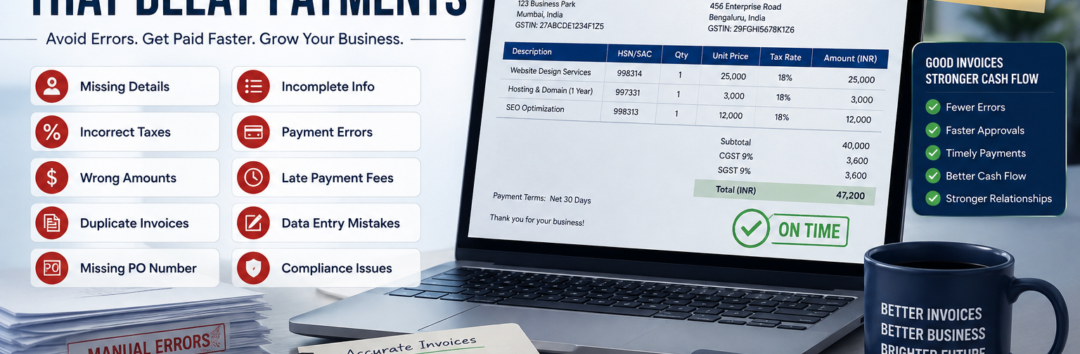
Are you looking for common mistakes that delays Payments ? Discover the most common invoice mistakes that delay payments and learn how to improve invoice accuracy, cash flow, GST compliance, and faster payment processing.
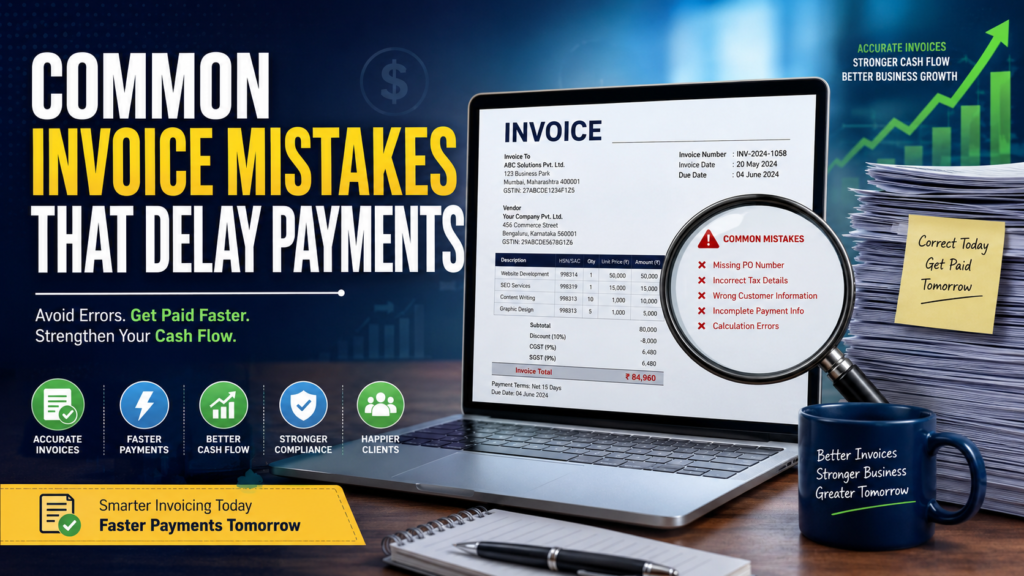
Common Invoice Mistakes That Delay Payments
Have you ever completed a project on time, delivered exceptional work, sent an invoice, and then… waited weeks—or even months—for payment?
You’re not alone.
One of the biggest reasons businesses struggle with delayed payments isn’t because customers refuse to pay. More often, payments are delayed because of avoidable invoicing errors.
A missing Invoice Number, an incorrect Invoice Date, inaccurate Customer Information, or even a forgotten Purchase Order (PO) Number can force your invoice into a lengthy review process before it ever reaches the finance team.
According to industry studies, invoice errors are among the leading causes of delayed payments, increased administrative costs, and strained customer relationships.
Every correction requires additional communication, document verification, and manual intervention—slowing down your entire billing cycle.
Whether you’re a freelancer, startup founder, accounting professional, or enterprise finance manager, understanding the Common Invoice Mistakes That Delay Payments can help you get paid faster, maintain healthy cash flow, and improve customer satisfaction.
In today’s digital business environment, invoices are no longer just payment requests. They are critical financial documents that support Accounts Receivable (AR), Accounts Payable (AP), tax compliance, audits, bookkeeping, and business reporting.
Even a small typo can create Invoice Discrepancies, trigger Approval Delays, or require additional Document Verification before payment can be released.
Modern organizations are increasingly replacing Manual Invoicing with Invoice Automation, AI Invoice Processing, OCR (Optical Character Recognition), and E-Invoicing platforms. These technologies reduce Data Entry Errors, improve Invoice Accuracy, accelerate Payment Processing, and provide complete visibility into the Invoice Lifecycle.
In this comprehensive guide, you’ll discover the most common invoice mistakes that delay payments, learn why they happen, and explore proven strategies to eliminate them using automation, standardized processes, and better financial controls.
Why Invoice Accuracy Matters More Than Ever
Many businesses view invoicing as an administrative task. In reality, invoicing is one of the most critical components of your revenue cycle. A single inaccurate invoice can impact collections, accounting, compliance, and customer trust.
Every invoice begins the Order-to-Cash (O2C) process. Once products or services are delivered, the invoice moves through multiple stages—from customer verification to approval, payment, reconciliation, and reporting. Any mistake along this journey can increase Invoice Processing Time and delay revenue recognition.
For companies managing supplier payments, invoices also play an essential role in the Procure-to-Pay (P2P) process. Finance departments compare invoices against purchase orders and delivery receipts using Purchase Order Matching or Three-Way Matching. If details don’t align, the invoice is flagged for review instead of being approved automatically.
An accurate invoice should include complete Vendor Information, correct Customer Information, the appropriate Billing Address, and, where applicable, the correct Shipping Address. Businesses operating under GST or VAT regulations must issue a valid Tax Invoice that satisfies GST/VAT Compliance requirements.
Missing or incorrect Tax Identification Number (GSTIN/VAT ID) details, inaccurate HSN/SAC Code entries, or an incorrect Tax Rate can result in rejected invoices and potential compliance issues.
Each invoice should clearly describe the goods or services being billed using detailed Line Item Description, accurate Product SKU, correct Quantity, and the agreed Unit Price. If discounts are offered, the Discount Calculation must be transparent and mathematically correct so the final Invoice Total matches contractual agreements.
Businesses serving international customers should also verify the Currency Code to avoid payment confusion. Similarly, clearly defined Payment Terms, Due Date, and any applicable Late Payment Fees help set expectations and reduce disputes.
Payment details are equally important. Missing Payment Instructions, incorrect Bank Account Details, unavailable UPI Payment options for domestic customers, or incorrect IBAN/SWIFT Code information for international transactions can significantly delay fund transfers—even when the invoice itself is approved.
When invoices are complete and accurate, organizations benefit from:
- Faster invoice approvals
- Quicker customer payments
- Reduced administrative costs
- Improved cash flow
- Better supplier relationships
- Stronger financial reporting
- Easier tax compliance
- Lower operational risk
On the other hand, inaccurate invoices often trigger repeated corrections, unnecessary email exchanges, and manual reviews. Finance teams must verify invoice details, compare documents, and resolve discrepancies before processing payments.
The result?
Longer collection cycles, delayed revenue, increased workload, and frustrated customers.
That’s why leading organizations prioritize Invoice Validation before sending invoices. Automated validation systems verify invoice data, detect missing fields, identify duplicate submissions, and ensure invoices comply with organizational policies before reaching customers.
In the next section, we’ll examine the most common invoice mistakes that delay payments—and explain how each one can impact your business operations.
The Most Common Invoice Mistakes That Delay Payments
Even businesses with experienced finance teams occasionally make invoicing mistakes. However, what appears to be a minor oversight can create a chain reaction that delays approvals, impacts cash flow, and increases operational costs.
Let’s explore the most common invoice mistakes that delay payments and learn how to avoid them.
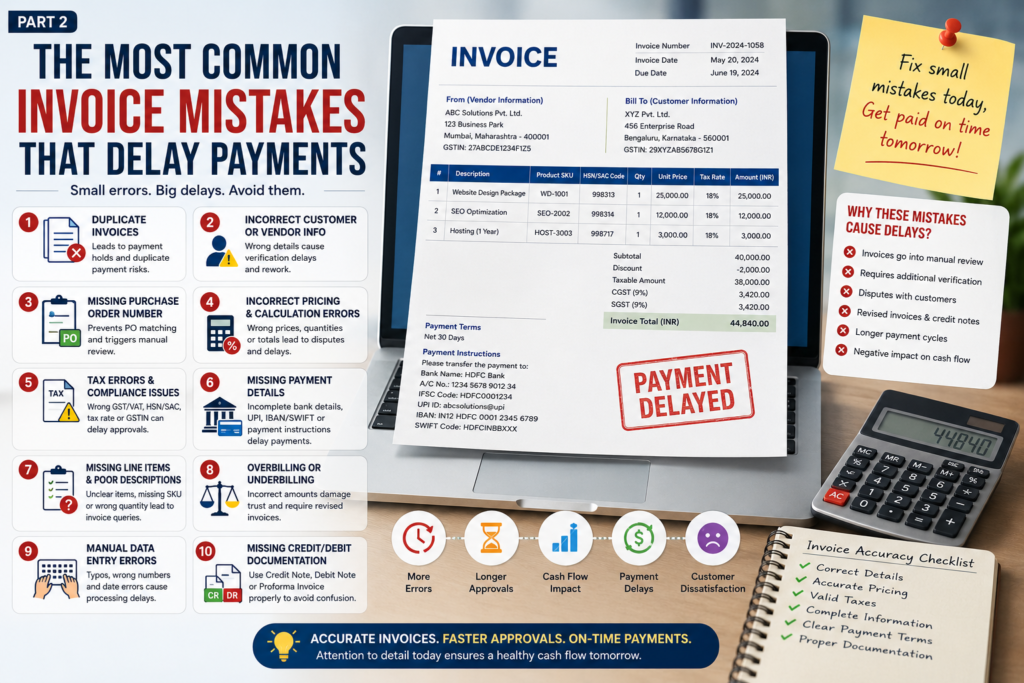
1. Duplicate Invoices and Duplicate Payments
One of the costliest invoicing mistakes is submitting a Duplicate Invoice. This can happen when invoices are manually generated, resent without updating records, or accidentally created by multiple team members.
Finance departments typically use automated controls to identify duplicate invoices before processing payments. While these checks protect businesses from Duplicate Payment, they also place invoices on hold until the issue is investigated.
For example, imagine a digital marketing agency completes a campaign and accidentally emails the same invoice twice. The client’s finance system detects the duplicate invoice, flags it for review, and removes it from the automated payment queue. What should have been a seven-day payment suddenly becomes a 30-day process.
How to avoid it
- Use sequential invoice numbering.
- Maintain centralized billing records.
- Enable duplicate detection within your billing software.
- Perform Invoice Validation before sending invoices.
- Track every invoice using Invoice Tracking dashboards.
2. Incorrect Customer or Vendor Information
Invoices are legal and financial documents. Even small mistakes in Customer Information or Vendor Information can prevent payment.
Common mistakes include:
- Incorrect company name
- Wrong contact person
- Old Billing Address
- Incorrect Shipping Address
- Missing GSTIN
- Incorrect Tax Identification Number
- Outdated customer records
Many enterprise organizations maintain a centralized Vendor Master Data repository. If the submitted invoice doesn’t exactly match the information stored in their ERP system, payment approval often stops immediately.
This is particularly common in government contracts and large corporations where strict procurement policies exist.
Best Practice
Always verify customer details before generating an invoice.
Modern Accounting Software Integration automatically synchronizes customer records, reducing manual errors.
3. Missing Purchase Order Numbers
Many organizations only process invoices that reference an approved Purchase Order (PO) Number.
Without it, finance teams cannot complete Purchase Order Matching, making it impossible to verify whether goods or services were actually ordered.
Large organizations often rely on Three-Way Matching, where three documents must match perfectly:
- Purchase Order
- Goods Receipt
- Supplier Invoice
If any value differs—even by a small amount—the invoice enters Exception Handling, delaying payment until procurement, warehouse, and finance teams resolve the discrepancy.
Example
A software development company invoices a corporate client but forgets to include the approved PO Number.
The invoice immediately enters manual review, adding several weeks to the payment cycle.
4. Incorrect Pricing and Calculation Errors
Calculation mistakes remain one of the most common invoice problems.
These include:
- Incorrect Unit Price
- Wrong Quantity
- Missing Discount Calculation
- Incorrect Invoice Total
- Incorrect Pricing
- Mathematical errors
Imagine selling 100 units at ₹250 each but accidentally invoicing ₹205 per unit.
Your customer now questions the invoice.
Finance teams request clarification.
Payment is paused.
A revised invoice must be generated.
Even simple arithmetic mistakes reduce confidence in your business.
Always verify:
- Product pricing
- Discounts
- Taxes
- Grand totals
Automated invoice software performs these calculations instantly and significantly improves Invoice Accuracy.
5. Tax Errors and Compliance Issues
Tax-related mistakes are among the most serious invoice errors because they affect both payment approval and legal compliance.
Businesses frequently make mistakes involving:
- Wrong Tax Rate
- Incorrect GST calculation
- Missing HSN/SAC Code
- Invalid Tax Identification Number (GSTIN/VAT ID)
- Improper Tax Invoice format
Failure to maintain GST/VAT Compliance may result in:
- Invoice rejection
- Customer disputes
- Tax penalties
- Delayed Input Tax Credit claims
For businesses operating internationally, VAT regulations differ significantly between countries.
Always ensure invoices comply with local tax laws before issuing them.
6. Missing Payment Details
An approved invoice cannot be paid if payment instructions are incomplete.
Common examples include:
- Missing Bank Account Details
- Incorrect IFSC code
- Invalid account number
- Missing UPI Payment QR code
- Wrong IBAN/SWIFT Code
- Incomplete Payment Instructions
International businesses frequently experience delays simply because overseas clients cannot identify the correct banking information.
Always verify payment methods before sending invoices.
Providing multiple payment options also improves customer experience.
7. Missing Line Items and Poor Product Descriptions
Invoices should clearly explain exactly what customers are paying for.
Problems arise when invoices contain:
- Missing Line Items
- Generic descriptions
- Missing Product SKU
- Poor Line Item Description
- Incorrect Quantity
Instead of writing:
Marketing Services
Use:
SEO Optimization Package – Monthly Retainer – Keyword Research, Technical Audit, Link Building – Product SKU DM102
Clear invoices reduce customer questions and improve approval speed.
8. Overbilling and Underbilling
Charging too much (Overbilling) damages customer trust.
Charging too little (Underbilling) reduces profitability.
Both scenarios create unnecessary invoice revisions.
Businesses should establish pricing review procedures before invoices are finalized.
Modern invoice software automatically compares quoted prices against billing records, helping prevent these costly mistakes.
9. Manual Data Entry Errors
Traditional Manual Invoicing depends heavily on human accuracy.
Unfortunately, repetitive typing often causes:
- Wrong invoice numbers
- Incorrect dates
- Spelling mistakes
- Missing decimals
- Wrong tax values
- Incorrect customer names
These Data Entry Errors significantly increase payment delays.
Modern businesses now use OCR (Optical Character Recognition) to capture invoice information automatically from scanned documents, dramatically reducing manual effort.
Even better, AI Invoice Processing validates extracted data before invoices enter approval workflows.
This combination improves speed, accuracy, and compliance while minimizing costly human mistakes.
10. Missing Credit and Debit Documentation
Businesses frequently issue revised invoices without proper supporting documents.
Instead of modifying original invoices incorrectly, companies should issue:
- Credit Note (to reduce invoice value)
- Debit Note (to increase invoice value)
Similarly, many businesses send estimates instead of invoices.
A Proforma Invoice is useful before payment but should not replace the final invoice used for accounting purposes.
Using the correct document at each stage keeps financial records accurate and avoids customer confusion.
How Invoice Automation Prevents Payment Delays
As businesses grow, relying on spreadsheets and manual billing processes becomes increasingly risky. A higher volume of invoices means more opportunities for errors, longer approval cycles, and delayed payments. This is where Invoice Automation transforms the invoicing process.
Modern billing platforms automate the entire Invoice Lifecycle—from invoice creation to payment collection—while reducing human intervention. Instead of manually checking every invoice, automated systems validate data, identify exceptions, and route invoices through predefined approval workflows.
Streamlining the Invoice Approval Workflow
An efficient Invoice Approval Workflow ensures that every invoice reaches the right person at the right time. Automated workflows can:
- Verify invoice details before submission.
- Route invoices to department heads for approval.
- Flag missing information automatically.
- Escalate overdue approvals.
- Notify finance teams when invoices are approved.
This significantly reduces Approval Delays, ensuring invoices move through the organization without unnecessary bottlenecks.
Digital Invoice and E-Invoicing
Many organizations have transitioned from paper invoices to Digital Invoice systems. Digital invoices are easier to track, store, and share, while reducing printing and mailing costs.
For businesses operating in jurisdictions that require electronic invoicing, E-Invoicing simplifies tax compliance and standardizes invoice submission. E-invoices are transmitted electronically, minimizing manual intervention and improving processing speed.
A PDF Invoice is also widely accepted because it preserves formatting and can be securely shared via email or accounting platforms.
To maintain consistency, businesses should use a standardized Invoice Template that includes all mandatory fields, payment information, tax details, and branding elements.
Improve Financial Accuracy with Better Controls
Preventing invoice errors requires more than careful data entry. Businesses need strong financial controls that ensure invoices are accurate before they are sent.
Payment Reconciliation
Once a customer makes payment, finance teams perform Payment Reconciliation by matching incoming payments against outstanding invoices.
Accurate reconciliation helps businesses:
- Confirm payments received.
- Identify partial payments.
- Detect short payments.
- Resolve customer disputes quickly.
Maintaining a detailed Audit Trail ensures every invoice update, approval, and payment action is recorded. This improves transparency, simplifies audits, and supports regulatory compliance.
Invoice Status Monitoring
Tracking Invoice Status in real time allows businesses to know whether an invoice is:
- Draft
- Sent
- Under Review
- Approved
- Paid
- Overdue
- Cancelled
Real-time visibility helps finance teams follow up proactively instead of waiting until payments become overdue.
Payment Reminders
Many late payments occur simply because customers forget the payment due date.
Automated Payment Reminder emails or SMS notifications encourage timely payments without creating uncomfortable conversations. Businesses can schedule reminders before and after the Due Date, reducing overdue invoices while maintaining positive customer relationships.
Detect Fraud and Strengthen Compliance
Invoice fraud continues to be a growing concern for organizations worldwide. Fraudsters may submit fake invoices, alter payment information, or attempt duplicate billing.
Implementing Invoice Fraud Detection measures helps organizations identify suspicious activities before payments are processed.
Examples include:
- Duplicate invoice detection.
- Vendor verification.
- Bank account validation.
- Unusual payment pattern analysis.
- AI-based anomaly detection.
Strong Compliance Requirements also demand accurate documentation, especially for tax reporting and financial audits.
Businesses should establish internal policies for:
- Invoice approvals.
- Tax verification.
- Supporting documentation.
- Record retention.
- Access controls.
These practices reduce financial risk while improving operational efficiency.
ERP Integration and Connected Accounting Systems
Many growing businesses use enterprise software to centralize financial operations.
Through ERP Integration, invoice data flows automatically between procurement, inventory, finance, and accounting systems.
Similarly, Accounting Software Integration synchronizes invoices with bookkeeping platforms, reducing duplicate work and eliminating manual data transfers.
Automated integrations improve:
- Invoice accuracy.
- Payment processing.
- Financial reporting.
- Tax compliance.
- Operational efficiency.
Electronic communication standards such as Electronic Data Interchange (EDI) also allow businesses to exchange invoices and purchasing documents securely without manual intervention.
When combined with automation, Straight-Through Processing (STP) enables invoices to move from receipt to payment without human involvement, provided all validation rules are satisfied.
This dramatically reduces processing costs while accelerating approvals.
Reduce Outstanding Receivables and Improve Cash Flow
Every delayed invoice directly impacts Cash Flow Management.
The longer invoices remain unpaid, the more difficult it becomes to fund daily operations, invest in growth, or pay suppliers on time.
Finance teams regularly monitor Outstanding Receivables using an Aging Report, which categorizes unpaid invoices based on how long they have remained outstanding.
Typical aging categories include:
- 0–30 Days
- 31–60 Days
- 61–90 Days
- 90+ Days
Businesses with high outstanding receivables often experience liquidity challenges.
Offering an Early Payment Discount can encourage customers to pay sooner, while clearly communicating Late Payment Fees discourages unnecessary payment delays.
Consistently monitoring receivables helps organizations prioritize collection efforts and maintain healthy cash flow.
Best Practices to Avoid Common Invoice Mistakes That Delay Payments
To improve invoice accuracy and accelerate payments, businesses should adopt the following best practices:
- Use standardized invoice templates.
- Validate invoices before sending them.
- Verify customer and vendor information regularly.
- Include accurate tax and payment details.
- Reference purchase order numbers whenever required.
- Automate calculations for pricing, taxes, and discounts.
- Implement invoice approval workflows.
- Track invoice status in real time.
- Send automated payment reminders.
- Integrate invoicing with ERP and accounting systems.
- Perform regular payment reconciliation.
- Monitor aging reports and outstanding receivables.
- Maintain complete audit trails for every transaction.
- Leverage AI-powered invoice automation to minimize manual effort.
By following these practices, businesses can reduce errors, shorten payment cycles, improve compliance, and strengthen customer relationships.
FAQ: Common Invoice Mistakes That Delay Payments
What is the most common invoice mistake that delays payments?
The most common issue is incomplete or inaccurate invoice information, including incorrect customer details, missing purchase order numbers, tax calculation errors, and incomplete payment instructions.
Why are purchase order numbers important?
Many organizations require a valid Purchase Order (PO) Number before processing invoices. Missing PO numbers often result in invoices being placed on hold until verification is completed.
How does invoice automation reduce errors?
Invoice automation validates invoice data, performs automatic calculations, detects duplicate invoices, routes invoices for approval, and integrates with accounting systems, significantly reducing manual errors.
What is invoice validation?
Invoice validation is the process of checking invoices for completeness, accuracy, compliance, duplicate submissions, and mathematical correctness before they are sent for approval or payment.
Can AI help improve invoice processing?
Yes. AI-powered invoice processing uses OCR, machine learning, and automation to extract invoice data, validate information, detect anomalies, reduce manual effort, and accelerate payment processing.
Conclusion: Common Invoice Mistakes That Delay Payments
Accurate invoicing is one of the foundations of a healthy business. Even seemingly small mistakes—such as incorrect pricing, missing purchase order numbers, incomplete payment details, duplicate invoices, or tax calculation errors—can disrupt approval workflows, delay payments, and strain customer relationships.
Fortunately, these issues are largely preventable. By adopting standardized invoice templates, validating invoice data, automating approval workflows, integrating with ERP and accounting systems, and leveraging AI-powered invoice automation, businesses can dramatically reduce invoicing errors while improving operational efficiency.
Ultimately, reducing the Common Invoice Mistakes That Delay Payments is not just about getting paid faster. It’s about strengthening financial controls, improving compliance, enhancing customer trust, and building a more resilient cash flow process that supports long-term business growth.
Ready to streamline your billing process? Invest in a modern invoice billing generator with automation, validation, and real-time tracking features to create accurate invoices, accelerate payments, and keep your business running smoothly.
Also Read: How to Generate GST Invoice Online in India
Follow Us On Youtube