 Post by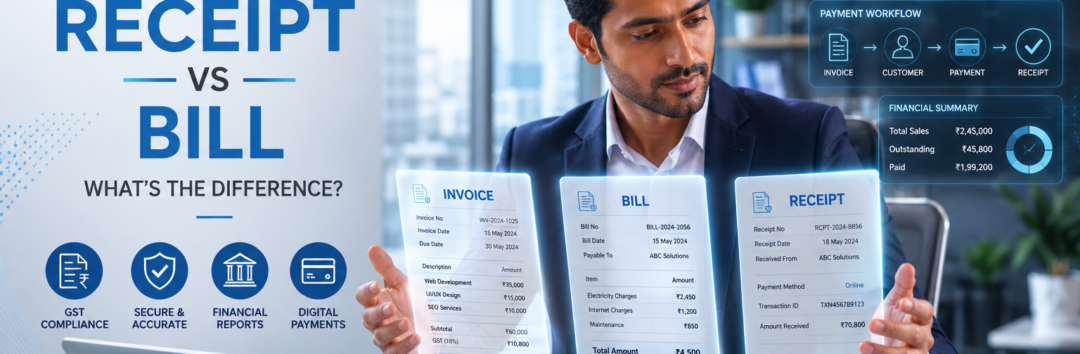
Invoice vs Receipt vs Bill: What’s the Difference? (Complete Guide for Businesses)
If you’ve ever run a business, worked in accounting, or even made an online purchase, you’ve probably come across documents like an Invoice, Bill, and Payment Receipt. While these terms are often used interchangeably, they actually serve very different purposes in a Business Transaction.
Many small business owners, freelancers, startups, and even established companies confuse these documents. Sending the wrong document at the wrong stage can lead to delayed payments, accounting errors, tax issues, and poor customer communication. Whether you’re issuing a Tax Invoice, collecting payments, or maintaining Accounting Records, understanding these differences is essential.
Imagine this common scenario:
You complete a website development project for a client. Once the work is finished, you send a Tax Invoice requesting payment. The client reviews the services listed under the Itemized Line Items, checks the Invoice Number, verifies the Invoice Date, and notices the agreed Payment Terms along with the Due Date. After making the payment, you provide a Payment Receipt as Proof of Payment. Throughout this process, each document has a distinct role, helping both the Seller and the Buyer maintain transparency and proper Financial Recordkeeping.
This distinction becomes even more important under India’s GST regulations. Businesses are required to issue a valid GST Invoice containing the correct GSTIN, taxable values, tax components, and other mandatory details. These documents also play an important role during audits, tax filing, and maintaining a complete Audit Trail.
In this comprehensive guide, you’ll learn:
- What an Invoice is and when to use it
- What a Bill means in different business situations
- What a Payment Receipt represents
- The complete Invoice Lifecycle
- Practical examples from everyday business
- Common misconceptions that lead to accounting mistakes
By the end of this guide, you’ll clearly understand when each document should be issued and how they contribute to efficient Cash Flow Management, accurate bookkeeping, and stronger customer relationships.
Understanding the Business Transaction Flow
Before diving into individual documents, let’s first understand where they fit within a typical Sales Transaction.
A simplified business process usually looks like this:
- Customer places an order.
- Sometimes a Purchase Order (PO) is created.
- Products or Goods and Services are delivered.
- The business sends an Invoice requesting payment.
- The customer pays the amount.
- The business issues a Payment Receipt confirming successful payment.
- The accounting team updates Accounting Records and closes the transaction.
Each document supports a different stage of this process. Understanding the sequence helps eliminate confusion and improves financial accuracy.
What Is an Invoice?
An Invoice is a formal commercial document issued by a Seller to a Buyer requesting payment for supplied Goods and Services.
Simply put, an invoice is a professional Payment Request.
It tells the customer:
- What was sold
- How much they need to pay
- When payment is due
- Applicable taxes
- Payment instructions
Unlike a receipt, an invoice does not confirm payment. Instead, it indicates that payment is expected according to the agreed Payment Terms.
Purpose of an Invoice
An invoice serves several important purposes.
It acts as:
- A legal business document
- A Payment Request
- A tax document
- A financial record
- Evidence of a completed sale
- A foundation for Accounts Receivable
Businesses rely on invoices to monitor unpaid customer balances and maintain healthy Cash Flow Management.
Key Components of an Invoice
A professional invoice typically contains the following information:
1. Invoice Number
Every invoice should have a unique Invoice Number.
This helps businesses:
- Track transactions
- Prevent duplicate billing
- Maintain organized Accounting Records
- Simplify audits
Example:
Invoice Number: INV-2026-1045
2. Invoice Date
The Invoice Date indicates when the invoice was created.
This date is important because it determines:
- Payment schedule
- Tax reporting
- Due date calculations
- Financial reporting periods
3. Due Date
The Due Date specifies when payment must be completed.
For example:
Invoice Date: July 7
Payment Terms: Net 15
Due Date: July 22
Clearly mentioning the Due Date reduces payment delays and improves customer communication.
4. Itemized Line Items
A professional invoice lists every product or service separately using Itemized Line Items.
Instead of writing:
Website Development – ₹50,000
A better invoice includes:
- UI Design
- Front-end Development
- CMS Integration
- SEO Setup
- Testing
Detailed descriptions improve transparency and reduce disputes.
5. Payment Terms
The Payment Terms explain how and when payment should be made.
Examples include:
- Net 15
- Net 30
- Due on Receipt
- 50% Advance
- Partial Payment Allowed
Clear payment terms help businesses reduce late payments and maintain predictable revenue.
6. Tax Details
A valid GST Invoice should include:
- Business name
- Customer information
- GSTIN
- Tax rates
- Tax amount
- Place of supply
- Invoice value
These details are mandatory for claiming input tax credit under GST regulations.
Why Businesses Need Invoices
Invoices are far more than payment reminders.
They help businesses:
- Track outstanding payments
- Monitor customer balances
- Improve Cash Flow Management
- Maintain legal documentation
- Generate financial reports
- Build trust with clients
Without invoices, managing Accounts Receivable becomes extremely difficult.
Real-World Example
Suppose a digital marketing agency completes SEO services worth ₹40,000.
The agency sends an invoice containing:
- Invoice Number
- Invoice Date
- Client information
- Service description
- Itemized Line Items
- GST
- Total amount
- Due Date
- Bank details
At this stage, payment has not yet been made.
The invoice simply communicates the amount due.
Invoice Lifecycle
Every invoice goes through several stages known as the Invoice Lifecycle.
These stages include:
Draft → Sent → Viewed → Approved → Paid → Archived
During this journey, businesses monitor the Payment Status to understand whether the invoice remains unpaid, partially paid, overdue, or fully settled.
Modern invoicing software automates much of this process, helping finance teams manage customer payments more efficiently.
What Is a Bill?
Although many people use “Invoice” and “Bill” interchangeably, they are not always the same.
A Bill is generally viewed from the customer’s perspective.
An invoice is issued by the Seller.
A bill is received by the Buyer.
Think of it this way:
When a restaurant hands you a document after your meal, you usually call it a bill.
When the restaurant records the same document internally, it may be treated as an invoice.
The document itself may contain similar information, but the terminology changes depending on perspective.
Bill vs Invoice Perspective
Seller’s View:
“I’ve issued an invoice.”
Buyer’s View:
“I’ve received a bill.”
Understanding this distinction is particularly useful for accounting teams working with both customers and suppliers.
Common Types of Bills
Businesses encounter several kinds of bills.
Examples include:
- Electricity bill
- Internet bill
- Water bill
- Mobile bill
- Restaurant bill
- Medical bill
- Vendor bill
Each one represents an amount payable.
Bills in Business Accounting
When a company receives a bill from a supplier, it becomes part of its Accounts Payable.
For example:
A printing company purchases paper from a supplier.
The supplier sends a bill worth ₹1,20,000.
Until payment is made, this amount appears under Accounts Payable.
Once payment is completed, the liability is removed from the books.
Vendor Bills
Businesses receive hundreds of bills every month from different Vendors.
Examples include:
- Office rent
- Internet services
- Software subscriptions
- Raw materials
- Equipment maintenance
Managing vendor bills efficiently helps companies avoid penalties and maintain good supplier relationships.
Bills and Cash Flow
Paying bills on time improves:
- Business reputation
- Supplier trust
- Credit relationships
Delayed bill payments may result in:
- Late fees
- Service interruptions
- Damaged business relationships
Proper bill management therefore contributes significantly to healthy Cash Flow Management.

What Is a Payment Receipt?
A Payment Receipt is a document issued after payment has been successfully received.
Unlike an invoice, it is not a payment request.
Instead, it serves as official Proof of Payment.
Once a customer completes payment, the business provides a receipt confirming that the transaction has been settled.
Purpose of a Payment Receipt
Receipts provide confidence to both parties involved in a transaction.
They confirm:
- Payment received
- Amount paid
- Payment method
- Transaction date
- Reference number
For customers, receipts are valuable records.
For businesses, they support accurate Financial Recordkeeping.
Key Information in a Receipt
A receipt generally includes:
- Business details
- Customer name
- Receipt number
- Receipt Date
- Amount paid
- Payment method
- Transaction ID
- Reference to the original invoice
- Payment Confirmation
Unlike invoices, receipts do not request payment because payment has already been completed.
Why Receipts Matter
Receipts help businesses:
- Resolve customer disputes
- Maintain tax compliance
- Support warranty claims
- Improve bookkeeping
- Complete the Sales Transaction
They also provide a reliable Audit Trail, making it easier to verify transactions during financial reviews or tax assessments.
Practical Example
Imagine a customer purchases office furniture worth ₹75,000.
The furniture company first sends a GST Invoice.
The customer transfers the payment.
Once the payment is verified, the company issues a Payment Receipt containing:
- Receipt number
- Receipt Date
- Invoice reference
- Amount received
- Mode of payment
- Authorized signature
The customer now has official Proof of Payment, and the business updates its records to reflect the completed transaction.
Invoice vs Receipt: A Quick Preview
Although we’ll explore detailed comparisons in the next section of this guide, it’s worth remembering one simple distinction:
An Invoice asks for payment.
A Payment Receipt confirms payment.
Understanding this single concept eliminates one of the most common sources of confusion in business documentation.
As businesses grow, mastering these foundational documents becomes essential for maintaining accurate records, improving customer trust, and ensuring smooth financial operations. In the next part of this guide, we’ll compare Invoice, Bill, and Receipt side by side, examine their roles in GST compliance, explore related documents like Credit Note, Debit Note, Proforma Invoice, and Delivery Challan, and explain how they fit into modern accounting workflows.
Invoice vs Bill vs Receipt: A Detailed Comparison
Now that you understand what an Invoice, Bill, and Payment Receipt are individually, it’s time to compare them side by side. While these documents may appear similar at first glance, they serve entirely different purposes during a Business Transaction.
Think of them as milestones in the payment journey:
- The Invoice starts the payment process.
- The Bill represents the amount owed from the customer’s perspective.
- The Payment Receipt marks the successful completion of the transaction.
Knowing which document to use—and when—helps businesses improve customer communication, maintain accurate Accounting Records, and avoid costly mistakes.
Comparison Table: Invoice vs Bill vs Receipt
| Feature | Invoice | Bill | Payment Receipt |
|---|---|---|---|
| Purpose | Payment Request | Amount payable by customer | Proof of Payment |
| Issued By | Seller | Usually viewed by the Buyer | Seller |
| Issued To | Buyer | Customer | Customer |
| Stage | Before payment | Before payment | After payment |
| Contains Payment Terms | Yes | Sometimes | No |
| Contains Due Date | Yes | Usually | No |
| Shows Outstanding Balance | Yes | Yes | No |
| Confirms Payment | No | No | Yes |
| Used for Tax | Yes (GST Invoice) | Sometimes | Yes (Record Keeping) |
| Accounting Impact | Accounts Receivable | Accounts Payable | Payment Recorded |
This comparison demonstrates why businesses should never substitute one document for another. Each document exists to solve a specific business need.
The Complete Invoice Lifecycle
Every successful Sales Transaction follows a structured Invoice Lifecycle. Understanding this process allows businesses to monitor every payment from start to finish.
A typical invoice lifecycle includes the following stages:
Stage 1: Customer Inquiry
A prospective customer contacts your business to purchase Goods and Services.
Example:
A company requests a quotation for digital marketing services.
Stage 2: Proforma Invoice (Optional)
Many businesses first issue a Proforma Invoice.
Unlike a regular invoice, it is not a tax document.
Instead, it provides an estimated cost before work begins.
A Proforma Invoice usually contains:
- Proposed services
- Estimated pricing
- Taxes
- Delivery expectations
- Payment schedule
Businesses commonly use this document for:
- International trade
- Manufacturing
- Custom projects
- Large service contracts
Stage 3: Purchase Order
Large organizations often issue a Purchase Order (PO) before the seller begins work.
A Purchase Order (PO) is created by the customer and authorizes the purchase.
It generally includes:
- Products ordered
- Quantity
- Agreed price
- Delivery timeline
- Company details
The PO protects both parties by documenting the agreed purchase.
Stage 4: Delivery of Goods or Services
After approval, the seller delivers the agreed Goods and Services.
Depending on the industry, this may involve:
- Physical products
- Consulting
- Software development
- Marketing services
- Equipment installation
For physical shipments, businesses may also prepare a Delivery Challan, especially when goods are transported before the final tax invoice is issued.
Stage 5: GST Invoice
Once delivery is completed, the business issues a GST Invoice.
This document officially requests payment.
A compliant GST Invoice generally includes:
- Business information
- Customer information
- Unique Invoice Number
- Invoice Date
- GSTIN
- Tax calculation
- Product description
- Itemized Line Items
- Total payable amount
- Payment Terms
- Due Date
This becomes the primary document used for taxation and accounting.
Stage 6: Payment Status Monitoring
Once the invoice has been sent, businesses begin tracking the Payment Status.
Typical statuses include:
- Draft
- Sent
- Viewed
- Pending
- Partially Paid
- Paid
- Overdue
- Cancelled
Monitoring payment status helps finance teams identify overdue customers quickly.
Stage 7: Payment Received
The customer pays the invoice using:
- Bank transfer
- UPI
- Credit card
- Debit card
- Cash
- Cheque
At this point, the Outstanding Balance becomes zero if the invoice has been fully paid.
Stage 8: Payment Receipt
After payment verification, the seller issues a Payment Receipt.
The receipt serves as official Payment Confirmation and provides Proof of Payment for both parties.
The transaction is now complete.
Understanding GST Invoice Requirements
In India, businesses registered under GST must issue a valid GST Invoice for taxable supplies.
A GST invoice is much more than a payment request.
It is also an important legal and taxation document.
Without a valid GST invoice, buyers may be unable to claim Input Tax Credit (ITC).
Mandatory Information on a GST Invoice
A compliant GST invoice generally contains:
- Business name
- Business address
- Customer details
- GSTIN
- Invoice serial number
- Invoice Date
- Description of Goods and Services
- HSN or SAC code
- Quantity
- Taxable value
- CGST
- SGST
- IGST (where applicable)
- Total invoice value
Businesses should always verify that all mandatory information is included before issuing invoices.
Why GST Compliance Matters
Proper GST documentation helps businesses:
- Avoid tax penalties
- Claim tax credits
- Maintain proper Accounting Records
- Support audits
- Improve financial transparency
For growing businesses, maintaining GST compliance becomes increasingly important as transaction volume increases.
Accounts Receivable vs Accounts Payable
Another area where many entrepreneurs get confused is understanding Accounts Receivable and Accounts Payable.
Let’s simplify both concepts.
What Is Accounts Receivable?
Accounts Receivable represents money customers owe your business.
Whenever you issue an Invoice, the amount moves into Accounts Receivable until payment is received.
Example:
You design a website worth ₹80,000.
You issue an invoice today.
The customer will pay after 30 days.
Until payment arrives, ₹80,000 appears under Accounts Receivable.
What Is Accounts Payable?
Accounts Payable represents money your business owes suppliers or Vendors.
Example:
Your office purchases laptops.
The supplier sends a bill.
Until payment is completed, the amount appears under Accounts Payable.
Once paid, the liability disappears.
Simple Formula
Money Coming In
= Accounts Receivable
Money Going Out
= Accounts Payable
Keeping these two categories separate allows businesses to understand their financial health more accurately.
Related Business Documents You Should Know
Invoices, bills, and receipts are only part of a much larger documentation system.
Several other documents play important roles during commercial transactions.
Credit Note
A Credit Note reduces the amount payable on an existing invoice.
Businesses issue credit notes when:
- Products are returned
- Discounts are applied later
- Services were overcharged
- Incorrect tax was charged
Example:
Original Invoice
₹50,000
Returned goods
₹5,000
Credit Note
₹5,000
Updated payable amount
₹45,000
Debit Note
A Debit Note performs the opposite function.
It increases the amount payable.
Businesses issue debit notes when:
- Additional products are supplied
- Prices increase
- Underbilling occurred
- Additional services were requested
Debit notes ensure accounting records remain accurate.
Delivery Challan
A Delivery Challan accompanies goods during transportation.
Unlike an invoice, it does not request payment.
Businesses commonly issue delivery challans when:
- Goods are sent for repair
- Goods are transferred between branches
- Products are sent for approval
- Stock is moved to warehouses
Later, the seller issues the official GST invoice.
Proforma Invoice
A Proforma Invoice is often misunderstood.
It resembles a standard invoice but is only a preliminary estimate.
It cannot replace a tax invoice.
Businesses use proforma invoices to:
- Share estimated costs
- Obtain customer approval
- Secure advance payments
- Explain pricing before production begins
Real-World Business Scenarios
Let’s examine how these documents work in everyday business.
Example 1: Freelance Graphic Designer
A freelancer designs a company logo.
Step 1
Client approves the quotation.
Step 2
Freelancer completes the project.
Step 3
An Invoice is issued.
Step 4
Client pays online.
Step 5
Freelancer sends a Payment Receipt.
Simple and efficient.
Example 2: Electronics Store
Customer purchases a laptop.
The cashier generates a Bill.
Customer pays immediately.
The system automatically prints a Payment Receipt.
Since payment happens instantly, the invoice and bill may appear almost identical to the customer.
Example 3: Manufacturing Company
A factory receives a Purchase Order (PO) from a retailer.
Products are manufactured.
Goods are shipped with a Delivery Challan.
The supplier issues a GST Invoice.
The retailer pays after 30 days.
The supplier issues a Payment Receipt.
This example demonstrates how multiple business documents work together within one transaction.
Common Mistakes Businesses Make
Many businesses unknowingly create accounting problems by using the wrong document.
Let’s explore some of the most common mistakes.
Mistake 1: Treating Bills and Invoices as Identical
Although similar, their usage depends on perspective.
Businesses should maintain consistent terminology across departments.
Mistake 2: Forgetting Payment Terms
Invoices without Payment Terms often lead to delayed payments.
Always specify:
- Due date
- Payment method
- Late fee policy
Mistake 3: Missing Invoice Number
Every invoice should contain a unique Invoice Number.
Duplicate numbers create confusion during audits.
Mistake 4: Poor Item Descriptions
Generic descriptions such as “Services Rendered” create unnecessary customer disputes.
Always include detailed Itemized Line Items.
Mistake 5: Not Issuing Receipts
Many businesses stop after receiving payment.
However, customers appreciate receiving a Payment Receipt because it provides official Proof of Payment.
Mistake 6: Ignoring Outstanding Balance
Businesses should regularly monitor Outstanding Balance reports.
Delayed follow-ups often result in cash flow problems.
Mistake 7: Weak Financial Recordkeeping
Incomplete documentation affects:
- Tax filing
- Audits
- Financial statements
- Business valuation
Maintaining organized Financial Recordkeeping protects businesses from unnecessary compliance issues.
Best Practices Before Moving Forward
As your business grows, documenting every Business Transaction accurately becomes increasingly important. A disciplined approach to invoices, bills, receipts, and related documents strengthens your Audit Trail, improves Cash Flow Management, and builds trust with customers and suppliers alike.
In the final part of this guide, we’ll look at practical best practices for document management, explain how automation can streamline billing, answer frequently asked questions, provide a comprehensive comparison matrix, and summarize the key differences between Invoice, Bill, and Payment Receipt to help you choose the right document every time.
Best Practices for Managing Invoices, Bills, and Receipts
As your business grows, the number of financial documents you handle increases rapidly. Whether you’re a freelancer issuing a handful of invoices each month or a company processing hundreds of transactions daily, adopting standardized processes helps maintain accuracy, improve compliance, and strengthen customer trust.
Here are some proven best practices every business should follow.
1. Create a Standardized Billing Process
A documented billing workflow ensures every Business Transaction follows the same process.
A recommended workflow looks like this:
- Receive customer inquiry
- Send quotation or Proforma Invoice
- Receive Purchase Order (PO) (if applicable)
- Deliver Goods and Services
- Generate GST Invoice
- Track Payment Status
- Receive payment
- Issue Payment Receipt
- Archive documents
Following a consistent process minimizes errors and improves operational efficiency.
2. Use Sequential Invoice Numbers
Every Invoice Number should be unique and generated in sequence.
For example:
- INV-2026-0001
- INV-2026-0002
- INV-2026-0003
Avoid manually editing invoice numbers, as duplicates can create issues during audits and tax filing.
3. Clearly Define Payment Terms
One of the most common reasons for delayed payments is unclear Payment Terms.
Include information such as:
- Payment due within 7, 15, or 30 days
- Accepted payment methods
- Advance payment requirements
- Late payment charges
- Installment options (if applicable)
Clear expectations reduce misunderstandings and improve collections.
4. Monitor Outstanding Balances Regularly
Many businesses focus on generating invoices but forget to follow up.
Review your Outstanding Balance report every week.
Identify:
- Overdue invoices
- Partial payments
- High-value unpaid invoices
- Frequently delayed customers
Timely follow-ups significantly improve Cash Flow Management.
5. Maintain Organized Financial Recordkeeping
Every invoice, bill, receipt, and supporting document should be stored securely.
Good Financial Recordkeeping helps with:
- GST filing
- Income tax returns
- Internal audits
- Financial reporting
- Loan applications
- Investor due diligence
Whether you use cloud software or physical files, consistency is key.
6. Preserve a Complete Audit Trail
Every financial document contributes to your company’s Audit Trail.
Keep records of:
- Original invoices
- Payment receipts
- Purchase orders
- Delivery challans
- Credit notes
- Debit notes
- Email approvals
- Payment confirmations
A complete audit trail makes it easier to verify transactions and resolve disputes.
How Automation Simplifies Billing
Modern invoicing software has transformed the way businesses manage documentation.
Instead of creating invoices manually, businesses can automate repetitive tasks while reducing human error.
Common automation features include:
- Automatic Invoice Number generation
- Real-time Payment Status updates
- Recurring invoices
- Automated payment reminders
- Digital Payment Confirmation
- GST calculations
- Customer database management
- Online payment integration
- Financial reports
- Receipt generation
Automation saves time and allows businesses to focus on growth rather than paperwork.
Invoice vs Bill vs Receipt: Real-Life Business Examples
Let’s explore how different industries use these documents.
Example 1: Digital Marketing Agency
A digital marketing agency signs a monthly SEO contract.
Step 1: Services are delivered.
Step 2: A GST Invoice is sent with the agreed Payment Terms.
Step 3: The client pays before the Due Date.
Step 4: The agency issues a Payment Receipt.
The accounting team updates Accounts Receivable and closes the transaction.
Example 2: Restaurant
A customer orders dinner.
The restaurant prints a Bill.
The customer pays immediately.
The cashier hands over a Payment Receipt.
Since payment happens instantly, many customers casually refer to both documents as the same thing, even though they serve different purposes.
Example 3: Wholesale Supplier
A retailer sends a Purchase Order (PO).
The supplier dispatches goods using a Delivery Challan.
After dispatch, a GST Invoice is generated.
The retailer pays after 30 days.
A Payment Receipt is issued once payment is received.
If some goods are returned, the supplier issues a Credit Note.
If additional items are supplied later, a Debit Note may be issued.
This example illustrates how multiple documents work together throughout the complete Invoice Lifecycle.
Common Myths About Invoices, Bills, and Receipts
Many misconceptions lead to accounting mistakes. Let’s address some of the most common ones.
Myth 1: Invoice and Bill Are Exactly the Same
Reality:
The terms often refer to the same commercial document, but the perspective differs.
- From the Seller’s side, it’s usually called an Invoice.
- From the Buyer’s side, it’s commonly called a Bill.
Myth 2: A Receipt Can Replace an Invoice
Reality:
A Payment Receipt confirms that payment has already been made.
It cannot replace an invoice because it doesn’t request payment or contain all the tax information required for invoicing.
Myth 3: Small Businesses Don’t Need Proper Documentation
Reality:
Regardless of business size, proper documentation supports compliance, improves customer confidence, and simplifies bookkeeping.
Myth 4: GST Is Only Relevant for Large Companies
Reality:
Businesses registered under GST must issue compliant GST Invoice documents, regardless of size, whenever applicable.
FAQs
1. Which document comes first: Invoice or Receipt?
An Invoice always comes before a Payment Receipt.
The invoice requests payment, while the receipt confirms payment.
2. Can a bill become an invoice?
In many industries, the same document may be referred to as a bill by the customer and an invoice by the business. The terminology depends on context and perspective.
3. Is a GST invoice mandatory?
If your business is registered under GST and the transaction falls under applicable GST rules, issuing a compliant GST Invoice is generally required.
4. What happens if payment is partially received?
The invoice remains open with an updated Outstanding Balance until the remaining amount is paid.
5. When should a Credit Note be issued?
A Credit Note is typically issued when:
- Goods are returned
- Services are cancelled
- Discounts are applied after invoicing
- Billing errors need correction
6. When is a Debit Note used?
A Debit Note is generally issued when:
- Additional charges arise
- Underbilling needs correction
- Extra goods or services are supplied after the original invoice
7. Why is a Purchase Order important?
A Purchase Order (PO) helps document the buyer’s authorization before goods or services are supplied. It reduces misunderstandings and supports procurement controls.
8. Why should businesses issue payment receipts?
A Payment Receipt provides official Proof of Payment, reassures customers, and strengthens Accounting Records.
Quick Summary Table
| Document | Primary Purpose | Issued By | Issued When |
|---|---|---|---|
| Invoice | Request payment | Seller | Before payment |
| Bill | Inform customer of amount due | Seller (viewed by Buyer) | Before payment |
| Payment Receipt | Confirm payment | Seller | After payment |
| Proforma Invoice | Provide estimated cost | Seller | Before order confirmation |
| Purchase Order (PO) | Authorize purchase | Buyer | Before delivery |
| Delivery Challan | Accompany transported goods | Seller | During delivery |
| Credit Note | Reduce invoice value | Seller | After invoicing (when needed) |
| Debit Note | Increase invoice value | Seller or Buyer (depending on context) | After invoicing (when needed) |
Key Takeaways
Let’s recap the most important differences:
- An Invoice is a formal Payment Request sent by the Seller to the Buyer.
- A Bill represents the amount payable, typically from the buyer’s perspective.
- A Payment Receipt serves as Proof of Payment after the transaction is completed.
- A GST Invoice includes mandatory tax information, such as the GSTIN, invoice details, and applicable tax amounts.
- A Purchase Order (PO) is created before the sale, while a Delivery Challan accompanies goods during transportation.
- Credit Note and Debit Note help correct or adjust previously issued invoices.
- Effective management of Accounts Receivable, Accounts Payable, Payment Status, and Outstanding Balance is essential for healthy Cash Flow Management.
- Maintaining organized Accounting Records, Financial Recordkeeping, and a complete Audit Trail supports compliance, reporting, and long-term business success.
Final Thoughts
Understanding the differences between an Invoice, Bill, and Payment Receipt is more than an accounting exercise—it’s a foundation for running a financially organized and trustworthy business.
Whether you’re a freelancer, startup founder, retailer, service provider, or enterprise finance professional, using the right document at the right stage of the Invoice Lifecycle improves communication, reduces payment disputes, supports tax compliance, and provides greater visibility into your finances.
As your business grows, consider standardizing your documentation process, automating routine tasks, and reviewing your financial workflows regularly. Small improvements in billing and recordkeeping can have a significant impact on cash flow, customer satisfaction, and operational efficiency.
The next time you create an invoice, receive a bill, or issue a receipt, you’ll know exactly where it fits in the transaction journey—and why each document matters.